
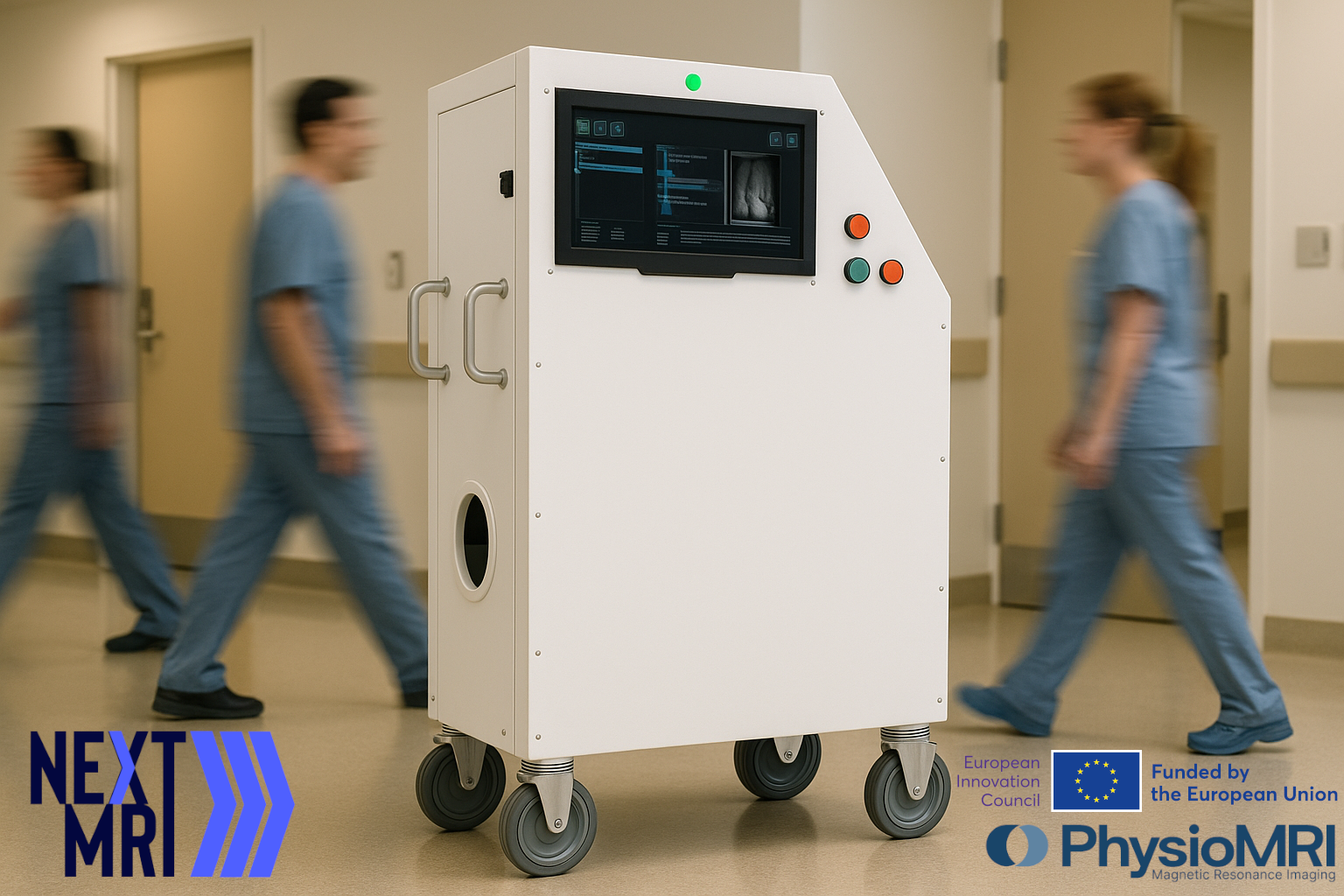
The post-processing software developed by PhysioMRI optimises images obtained with low-intensity MRI scans, ensuring high-quality clinical results.
The Valencian company PhysioMRI is at the forefront of the development of truly portable magnetic resonance imaging (MRI) systems. As part of its NextMRI project, it has incorporated state-of-the-art post-processing software designed to maximise the diagnostic quality of images acquired with low-intensity magnetic fields.
This software is not limited to mere basic adjustments: it incorporates an interface that allows the clinical operator or technician to intuitively intervene on artifacts, noise, segmentations, and reconstructions. In the case of the new MRI, given that the scanner works with a reduced magnetic field compared to conventional systems, the presence of noise and the lower signal-to-noise ratio constitute a key challenge.
Main features of post-processing software
- Module differences: the software has different sections that handle specific tasks, such as image data, image processing, and image post-processing, among others.
- Accessible user interface: Designed for technicians and radiologists, the interface features intuitive control panels for visual review of slices, adjustment of image noise filters, contrast scaling, or review of motion artifacts.
- Export and integration: The system allows exporting in standard format (DICOM) and integration with PACS systems, facilitating the inclusion of these images in routine clinical workflows.
Impact on clinical practice
Thanks to this post-processing software and the NextMRI portable platform, smaller healthcare centers or those located in rural areas will be able to access diagnostic-quality MRI images without relying on traditional large scanners. This speeds up diagnosis, improves accessibility, and reduces structural costs.
With this approach, PhysioMRI not only offers portable hardware but also a robust software ecosystem that enables its use in a variety of clinical settings, with control that reinforces diagnostic reliability in ‘in situ’ conditions.
