
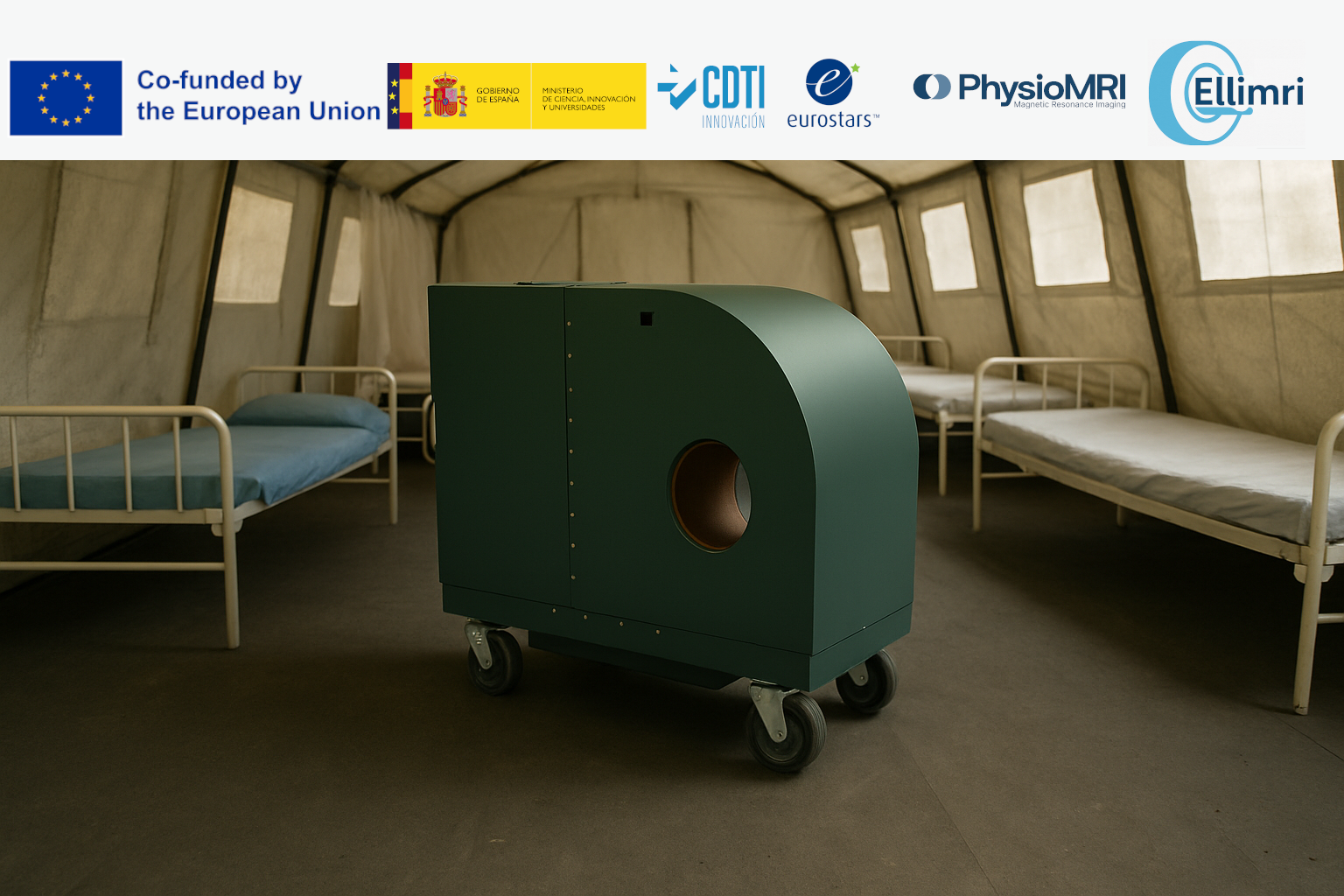
PhysioMRI is committed to an agile and resilient diagnostic model for emergencies, rural areas and hard-to-reach environments
PhysioMRI, a company specialising in the research and development of portable magnetic resonance imaging (MRI) scanners, has made significant progress in the ELLIMRI Project, a line of portable MRI scanners designed specifically to operate in extreme environments. The objective is clear: to bring high-quality diagnostic imaging to contexts where conventional MRI is unfeasible, whether due to lack of infrastructure, energy limitations or adverse environmental conditions. At a time when medicine is seeking to reduce access gaps, this device is positioned as a technological response aimed at rural areas, humanitarian emergencies, and field hospitals.
One of the main milestones of the project is the optimisation of the system to work with minimal resources. The new MRI scanner has been designed with a compact and robust architecture, prioritising operational stability in the face of temperature variations, dust, humidity and vibrations associated with transport. Unlike traditional installations, which require dedicated rooms and auxiliary equipment, PhysioMRI’s approach is ‘install and operate’: rapid deployment, simplified calibration and continuous operation in complex logistics environments.
At the same time, the project has focused on energy autonomy. The latest developments incorporate optimised consumption modes, designed to work with unstable electricity grids, generators or hybrid solutions. This is particularly important for rural areas and rapid response devices in the event of disasters, where the continuity of clinical service depends, to a large extent, on the equipment’s ability to adapt to the reality on the ground.
Another notable advance is the evolution of the clinical workflow. The medical device is geared towards agile and repeatable protocols that facilitate its use by healthcare teams with different levels of specialisation. The integration of support software guides image acquisition and reduces operational errors. In addition, the system is designed to integrate with telemedicine circuits, so that scans can be monitored or reported remotely when there is no radiologist on site.
With the ELLIMRI project, PhysioMRI is not only seeking to miniaturise complex technology, but also to redefine where and when magnetic resonance imaging can be performed. The potential impact is significant: earlier diagnosis, better-informed clinical decisions and frontline care capabilities, even in the most demanding scenarios. In short, this medical device represents a significant step towards truly mobile, resilient and accessibility-focused medical imaging.
