
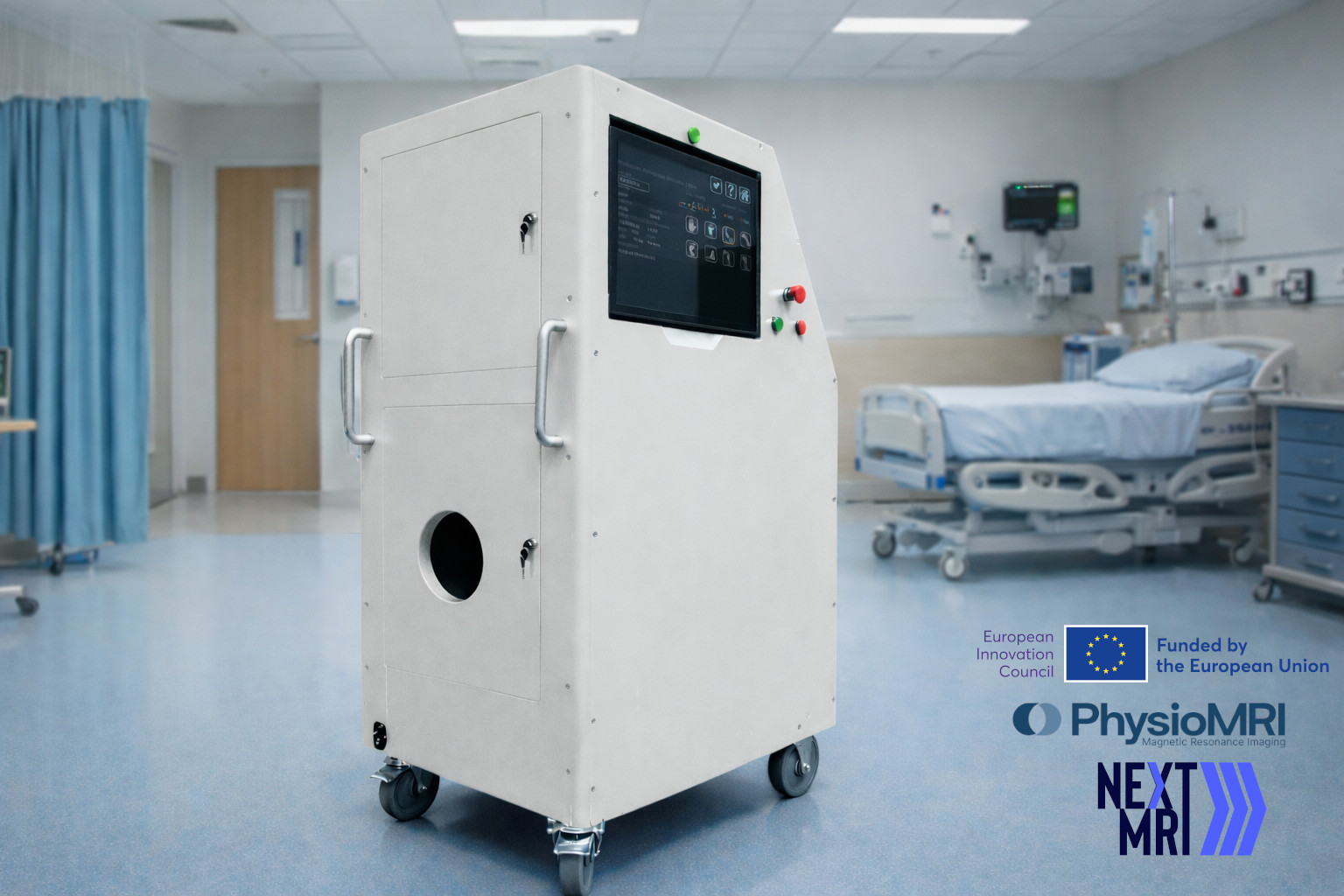
The role of NextMRI in hospital wards and emergency departments
PhysioMRI, a Spanish company dedicated to the Medtech sector, is working on the development of NextMRI, a portable magnetic resonance imaging device designed to transform the use of medical imaging in hospital settings where conventional MRI is limited or simply unfeasible. Its proposal responds to a growing need: to bring the diagnostic capabilities of MRI to where the patient is, without relying on shielded rooms or complex transfers.
One of the key settings for resonance imaging is hospital patient rooms. In many cases, especially for bedridden patients or those with reduced mobility, transfer to a central radiology department involves clinical risks, resource consumption and diagnostic delays. A portable system allows basic extremity scans to be performed directly in the patient’s room, facilitating progress monitoring and supporting clinical decisions without disrupting the patient’s stability.
Emergency rooms represent another strategic area. In contexts where time is a decisive factor, having a portable MRI scanner can speed up the diagnostic process in selected cases, complementing other imaging techniques such as X-rays or CT scans. Although the portable device is not intended to replace high-powered systems, it does aim to fill a gap: providing useful clinical information quickly, safely and close to the point of care.
From an operational standpoint, the development of NextMRI focuses on clinical usability. The device’s design, simplified scanning protocols, and advanced post-processing support are intended to enable healthcare personnel to integrate it into their routine without the need for complex infrastructure. This approach is key to its adoption in hospital areas not originally designed to house MRI equipment.
Overall, the role of this portable MRI scanner in diverse hospital settings points to a paradigm shift: moving from a model focused on transferring the patient to the equipment to one in which the technology adapts to the clinical environment. With this approach, PhysioMRI is moving towards more accessible, flexible MRI that is aligned with the real needs of everyday hospital practice.
