by Editorial Team | Jun 23, 2025 | NextMRI
The post-processing software developed by PhysioMRI optimises images obtained with low-intensity MRI scans, ensuring high-quality clinical results.
The Valencian company PhysioMRI is at the forefront of the development of truly portable magnetic resonance imaging (MRI) systems. As part of its NextMRI project, it has incorporated state-of-the-art post-processing software designed to maximise the diagnostic quality of images acquired with low-intensity magnetic fields.
This software is not limited to mere basic adjustments: it incorporates an interface that allows the clinical operator or technician to intuitively intervene on artifacts, noise, segmentations, and reconstructions. In the case of the new MRI, given that the scanner works with a reduced magnetic field compared to conventional systems, the presence of noise and the lower signal-to-noise ratio constitute a key challenge.
Main features of post-processing software
- Module differences: the software has different sections that handle specific tasks, such as image data, image processing, and image post-processing, among others.
- Accessible user interface: Designed for technicians and radiologists, the interface features intuitive control panels for visual review of slices, adjustment of image noise filters, contrast scaling, or review of motion artifacts.
- Export and integration: The system allows exporting in standard format (DICOM) and integration with PACS systems, facilitating the inclusion of these images in routine clinical workflows.
Impact on clinical practice
Thanks to this post-processing software and the NextMRI portable platform, smaller healthcare centers or those located in rural areas will be able to access diagnostic-quality MRI images without relying on traditional large scanners. This speeds up diagnosis, improves accessibility, and reduces structural costs.
With this approach, PhysioMRI not only offers portable hardware but also a robust software ecosystem that enables its use in a variety of clinical settings, with control that reinforces diagnostic reliability in ‘in situ’ conditions.


by Editorial Team | May 20, 2025 | NextMRI
An innovative proposal that combines portability, precision, and efficiency in medical imaging
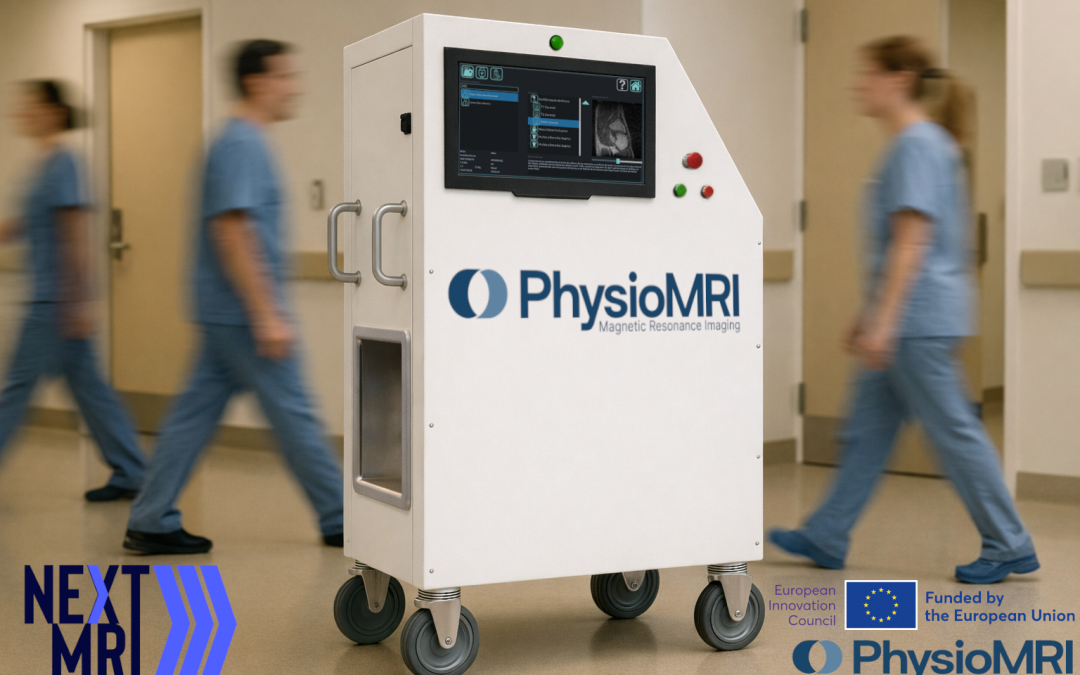
PhysioMRI, a leading Spanish company in the field of research and development of portable magnetic resonance imaging (MRI) technologies, continues to make progress on the NextMRI project, a proposal that redefines the way diagnostic imaging systems are conceived and used. This portable MRI scanner is characterised by its compact, ergonomic and highly functional design, designed to maximise accessibility and efficiency in clinical and research environments.
The design of the equipment is based on a robust and mobile structure, with a white casing featuring clean lines and smooth surfaces that convey a sense of precision and modernity. The device is mounted on four wheels for easy movement, allowing it to be moved between rooms effortlessly. This mobility makes PhysioMRI’s MRI scanner an ideal tool for environments where space or traditional MRI scanner infrastructure are limiting factors.
The side panel is dominated by a large-format touchscreen, from which the system is controlled and the acquired images are displayed. The interface combines an intuitive layout with a technological aesthetic, designed for real-time use by medical professionals or researchers. Next to it, a set of physical control buttons—in green and red—provides redundancy and safety during device operations, ensuring easy handling even in demanding clinical conditions.
Another noteworthy aspect of the design is the inclusion of handles and a rear access door with a circular opening, as part of the rear of the gantry (main hole of the resonance). These details reflect the attention paid to ergonomics and maintenance, fundamental aspects for a device that seeks to combine scientific precision with practicality for everyday use.
The philosophy behind this innovative project is clear: to take magnetic resonance imaging beyond traditional limits, providing a flexible and accessible platform that maintains image quality and diagnostic reliability, but with a simplified infrastructure. In this sense, the design not only serves an aesthetic function, but also embodies PhysioMRI’s vision of democratising access to MRI technology through portable, sustainable and efficient solutions.
With its vision of portable magnetic resonance imaging, PhysioMRI reaffirms its commitment to innovation applied to human well-being, promoting a new generation of magnetic resonance imaging systems that combine mobility, precision and intelligent design, paving the way towards a future in which advanced diagnostics are truly accessible anywhere.
by Editorial Team | Apr 11, 2025 | NextMRI
The NextMRI project heralds a new era of mobile and accessible diagnostics
PhysioMRI is a Spanish company pioneering the development of portable low-field magnetic resonance imaging (MRI) systems, and one of its most ambitious projects is NextMRI. This project represents a qualitative leap in medical imaging technology, combining portability, energy efficiency and powerful software to achieve an accessible, high-quality diagnostic solution.
Start of the project
NextMRI has its origins in previous work carried out by the Institute of Instrumentation for Molecular Imaging (i3M), a joint centre run by the Polytechnic University of Valencia (UPV) and the Spanish National Research Council (CSIC). Thanks to several patents developed by i3M and the involvement of its spin-off PhysioMRI Tech SL, magnetic resonance images had already been obtained in non-clinical settings: offices, outdoors, and even homes.
In October 2023, the project was formalised under a grant agreement with the European Innovation Council (EIC). It will run from 1 October 2023 to 30 September 2026.
Funding
The total budget for the NextMRI project is fully funded by the European Union through the EIC. PhysioMRI Tech SL participates as one of the beneficiaries of the consortium, alongside the CSIC, La Fe Hospital (IIS La Fe) and other clinical and technological partners (Bergman Clinics or Leiden University Medical Center), including international institutions.
The funding objectives are ambitious: to expand the technology to acquire images of extremities (such as knees or hands), integrate machine learning algorithms to improve image reconstruction, optimise device portability, reduce production costs, conduct clinical trials, and lay the foundations for a sustainable business model.
NextMRI project website
The project has its own official website, with the domain nextmri.eu. On this page, you can find detailed information about the scientific background, objectives, methodology, participating consortium, and the different phases of the project.
At the same time, PhysioMRI maintains its institutional website at physiomri.com, where it describes its developments in portable magnetic resonance imaging (such as its low-field scanner), its mission — to ‘democratise magnetic resonance imaging’ with accessible equipment that is not tied to traditional hospital infrastructure — and its recent advances. Its blog features posts about NextMRI, explaining how the innovative software improves image quality even when the magnetic field is lower, and how the equipment is designed to be compact, ergonomic, and mobile.
Conclusion
NextMRI is a transformative initiative: by combining PhysioMRI’s expertise in portable magnetic resonance imaging with European funding, and incorporating state-of-the-art software to improve image quality, the project aims to take magnetic resonance imaging beyond large hospitals. Its website offers a clear window into the state of development, clinical objectives and collaborators, and its ambitious business plan could mark a turning point in access to diagnostic imaging.
