
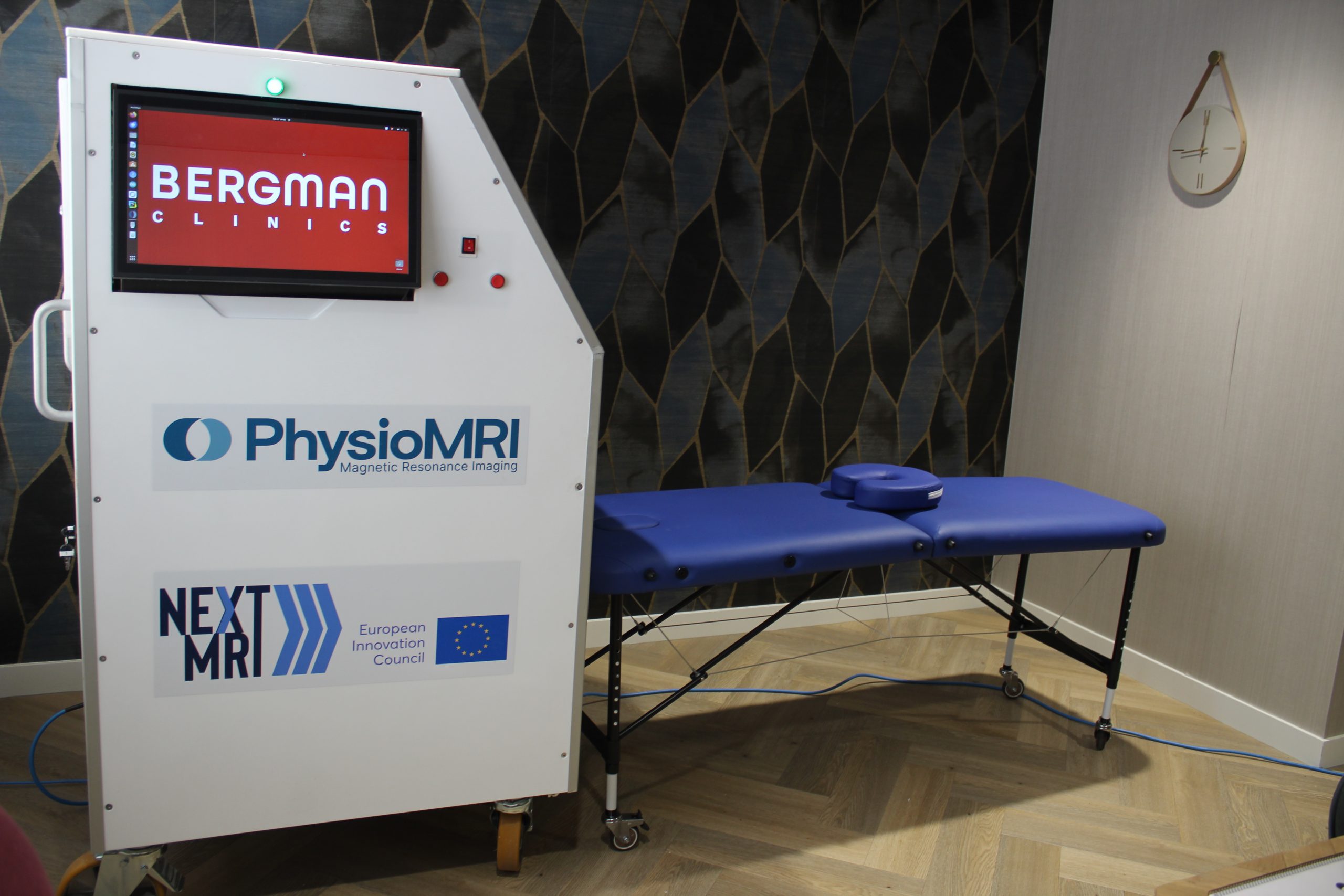
The clinical trials conducted by PhysioMRI at Bergman Clinics in the Dutch city of Breda form part of the current phase of the NextMRI project. As part of this, the company has transported a portable MRI scanner with a magnetic field strength of less than 0.1T from Valencia to continue gathering clinical data and assessing the potential of this technology in real-world conditions.
The equipment was transported by road on Monday 23 February and arrived in Breda the following evening. By Wednesday morning, the system was already in place at Bergman Clinics, and less than an hour after its arrival, it was fully operational and capturing its first images.
Rapid deployment in a real-world clinical setting
The roll-out of the system at Bergman Clinics highlights one of the operational advantages of this type of solution: its ability to be transported, installed and activated within a short timeframe.
After downloading the software and carrying out the necessary checks, the scanner was up and running in just 50 minutes. This speed is particularly important in the development of new imaging solutions designed to expand the potential applications of magnetic resonance imaging in a variety of settings.
Knee studies and comparison with 1.5-Tesla systems
Over the coming months, the system will remain at Bergman Clinics as part of the work planned under the NextMRI project. During this period, more than 100 patients will undergo MRI scans of the knee using this portable low-field scanner.
In addition, the same patients will also be examined using a 1.5-tesla (1.5T) system. This comparison will enable us to continue improving the images obtained using low-field MRI by comparing them with data from higher-field systems.
Generation of clinical data within the NextMRI project
At the same time, a similar system is in place at La Fe Hospital in Valencia, where comparable trials are being conducted to gather further clinical data, in this case in the field of neuroimaging.
Collaboration between the two fields will enable the creation of a database of paired images, a key resource for analysing which types of conditions can be detected using low-field MRI systems and for continuing to assess their potential in future applications.
PhysioMRI continues to make progress in the development of new imaging solutions
Through its participation in NextMRI, PhysioMRI continues to drive the development of new portable MRI solutions and to strengthen its focus on technological innovation, real-world validation and improving access to medical imaging.
The collaboration with centres such as Bergman Clinics and La Fe Hospital represents a significant step in this process and enables us to continue building up a body of technical and clinical knowledge regarding low-field magnetic resonance imaging.