
by Editorial Team | Jul 10, 2025 | General News
The first portable magnetic resonance imaging device, developed with technology from the Valencian company and backed by prominent investors such as Claver and Rodrigo del Prado, is expected to go on sale in 2027
The Spanish company PhysioMRI, specialized in research and development of portable magnetic resonance imaging (MRI) technologies, has been officially launched with its innovative tech-medical initiative, aiming to radically transform access to and application of MRI in clinical, research, and hard-to-reach settings, such as field hospitals.
The launch event, held at the Veles e Vents building in Valencia, brought together prominent professionals from the medical, technological, and scientific fields, as well as project investors. Among the attendees were Rodrigo del Prado, founder of the Spanish tech brand BQ, Víctor Claver, former player of Valencia Basket and the Spanish National Basketball Team, and Dr. Luis Martí Bonmatí, Director of the Medical Imaging Clinical Area at the University and Polytechnic Hospital La Fe in Valencia. Four of PhysioMRI’s co-founders also took part in the event: Alfonso Ríos (CEO), José María Benlloch, Joseba Alonso, and Jonatan Fatelevich.
During his speech, Alfonso Ríos addressed several key aspects of the company, such as financial management — where audits and project verification are conducted — and the MRI manufacturing and production environment, emphasizing that “this is the place where all the reception and assembly processes take place.” He also pointed out that all the MRI machines they’ve built so far “function the same way.” Furthermore, he highlighted the Quality System division, where certifications are obtained, including the official certification required for the manufacturing of medical devices.
In his turn to speak, José María Benlloch stated: “We are looking at a technology that can bring MRI to every clinic, every hospital, every corner of the world where it is currently inaccessible. This is not an evolution — it’s a revolution in access to medical diagnostics.”
Meanwhile, Joseba Alonso offered a more detailed perspective on the development of the MRI system. He explained how this new generation of portable scanners integrates advanced ultra-low magnetic field technologies, custom acquisition electronics, and image reconstruction algorithms based on artificial intelligence. Alonso also highlighted another vital feature of PhysioMRI’s new machines: portability. “What would be needed to transport the MRI to places like a village in Africa? You’d need a trailer, anchors, stabilizers, or a ramp to lower the device and perform MRIs outside the trailer itself.”
During Alonso’s presentation, a technical demonstration of the functional prototype of the medical device was carried out, sparking great interest among attendees, especially due to its compact design, intuitive interface, and ability to acquire clinically relevant images in a matter of minutes.
Lastly, Jonatan Fatelevich, who oversees the strategic and commercial side of the project, stated: “We want to place our MRI in every clinic in the world.” He also emphasized their goal to adopt a “pay-per-use” model, referring to the payment system used for photocopiers, at a much lower cost than traditional MRI scans. Based on this strategy and calculations, he noted that if a clinic performed 10 MRIs per day for 22 days a month, the investment in the medical device would be recovered in about six months.
In this way, PhysioMRI reaffirms its position as a European leader in portable MRI technologies, betting on disruptive innovation in the service of healthcare and science.
by Editorial Team | Jun 30, 2025 | ELLIMRI
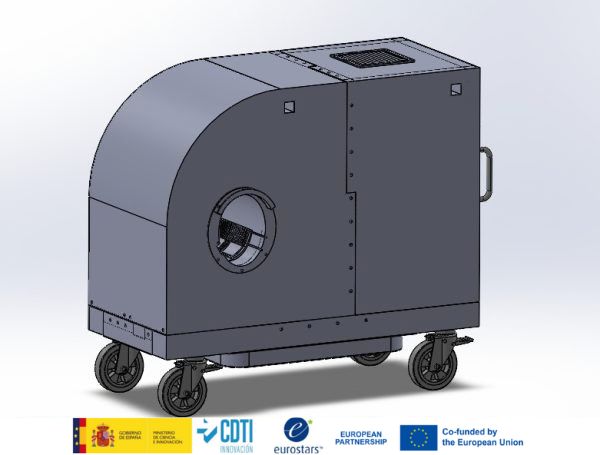
The development of this new MRI implements features such as portability, low magnetic intensity magnets or AI for medical image reconstruction.
Medical technology is progressing rapidly day by day, and one of the areas that has undergone a significant transformation in recent years is magnetic resonance imaging (MRI). In this context, the Spanish company PhysioMRI, dedicated to the research and development of innovative solutions in the field of portable MRI, has started to develop its latest product: ELLIMRI, a low-field MRI system designed to offer accessibility, efficiency and portability without compromising diagnostic quality.
Unlike traditional MRI scanners, which require complex facilities, dedicated spaces and high-intensity magnetic fields, this portable MRI is based on a low-field magnet design, which significantly reduces its size, operating cost and infrastructure needs. Thanks to its compact construction, the new device can be easily transported and installed in a variety of environments, including rural clinics, mobile units and even in emergency or low-resource settings.
One of the most innovative aspects of this MRI device is its true portability. The system has been designed with mobility in mind, allowing it to be moved by a single person or by light transport equipment. This opens up the possibility of performing MRI studies in places where it was previously unfeasible, extending access to this technology to patients who, for geographical or logistical reasons, could not benefit from a traditional MRI.
Despite operating in a lower magnetic field range, the new medical device maintains image quality suitable for medical studies, especially in musculoskeletal and emergency medicine. Its image reconstruction software, optimised by advanced artificial intelligence algorithms, compensates for the typical limitations of low-field systems, enabling clear and diagnostically useful images.
In addition, the portable MRI stands out for its energy efficiency and low operating cost. As it does not require cryogenic cooling systems or expensive magnetic shielding, it represents a sustainable and cost-effective solution, ideal for healthcare facilities with limited resources or those looking to reduce their energy footprint.
With this project, the Spanish company not only proposes an innovative technological solution, but also drives a paradigm shift in the way MRI is conceived: from a centralised, high-cost tool to an accessible, flexible and decentralised care-oriented device. PhysioMRI is thus positioning itself as a benchmark in the democratisation of diagnostic imaging, bringing high-precision healthcare to every corner of the world.
This project has received funding from the “Eurostars-3” program, with co-funding from the CDTI and the European Union’s “Horizon Europe” Framework Program for Research and Innovation.

by Editorial Team | Jun 23, 2025 | NextMRI
The post-processing software developed by PhysioMRI optimises images obtained with low-intensity MRI scans, ensuring high-quality clinical results.
The Valencian company PhysioMRI is at the forefront of the development of truly portable magnetic resonance imaging (MRI) systems. As part of its NextMRI project, it has incorporated state-of-the-art post-processing software designed to maximise the diagnostic quality of images acquired with low-intensity magnetic fields.
This software is not limited to mere basic adjustments: it incorporates an interface that allows the clinical operator or technician to intuitively intervene on artifacts, noise, segmentations, and reconstructions. In the case of the new MRI, given that the scanner works with a reduced magnetic field compared to conventional systems, the presence of noise and the lower signal-to-noise ratio constitute a key challenge.
Main features of post-processing software
- Module differences: the software has different sections that handle specific tasks, such as image data, image processing, and image post-processing, among others.
- Accessible user interface: Designed for technicians and radiologists, the interface features intuitive control panels for visual review of slices, adjustment of image noise filters, contrast scaling, or review of motion artifacts.
- Export and integration: The system allows exporting in standard format (DICOM) and integration with PACS systems, facilitating the inclusion of these images in routine clinical workflows.
Impact on clinical practice
Thanks to this post-processing software and the NextMRI portable platform, smaller healthcare centers or those located in rural areas will be able to access diagnostic-quality MRI images without relying on traditional large scanners. This speeds up diagnosis, improves accessibility, and reduces structural costs.
With this approach, PhysioMRI not only offers portable hardware but also a robust software ecosystem that enables its use in a variety of clinical settings, with control that reinforces diagnostic reliability in ‘in situ’ conditions.

by Editorial Team | May 27, 2025 | Check Health
Check Health combines advanced technology and portability to transform cancer prevention into health.
The Spanish company PhysioMRI, a pioneer in the development of portable magnetic resonance imaging, has presented its new Check Health project, an initiative aimed at revolutionising cancer prevention and monitoring through accessible, non-invasive and low-cost medical imaging technologies.
One of the project’s main strengths is its ability to facilitate early cancer detection in resource-limited settings. Thanks to a portable, affordable and energy-efficient design, the MRI scanner can be deployed in rural health centres, community clinics and hospitals with limited infrastructure. This overcomes geographic and economic barriers that have historically prevented access to advanced diagnostic technologies. By bringing this tool to vulnerable communities, it expands opportunities to identify cancer in its early stages, when the chances of successful treatment are significantly higher.
Another key aspect of the project is its focus on non-invasive, high-precision diagnostics. Check Health incorporates artificial intelligence and advanced image processing techniques to deliver high-quality diagnostic results at a fraction of the cost of conventional MRI scans. This allows for more accurate detection of abnormalities without the need for invasive procedures, reducing risks to the patient and optimising care times. This combination of accessibility and accuracy makes Check Health a powerful tool for improving the quality of cancer diagnostics in settings where such resources have not traditionally been available.
Other objectives of the company with its new MRI are: to contribute to the sustainability of the global healthcare system by reducing the operational costs associated with traditional MRI, thus facilitating its use in different clinical settings; to strengthen the global response to cancer by increasing the chances of early detection in rural areas or areas with limited medical infrastructure, thus helping to save lives and improve the well-being of patients.
Check Health‘s value proposition is based on three key pillars: accessibility, personalisation and prevention. Using low magnetic field technology with artificial intelligence algorithms for image reconstruction and automated analysis, the system enables fast, safe and repeatable scans in any environment, from primary care centres to mobile clinics.
With Check Health, PhysioMRI reaffirms its vision of democratising MRI and extending its impact beyond hospital diagnosis. By putting the power of medical imaging at the service of prevention, the company marks a decisive step towards a more proactive, accessible and people-centred healthcare model.

by Editorial Team | May 21, 2025 | ELLIMRI
PhysioMRI presents an innovative, low-field, high-efficiency solution to bring quality diagnostic imaging to any location in the world.
This project has received funding from the “Eurostars-3 Call 4” program, with co-funding from the CDTI and the European Union’s “Horizon Europe” Framework Program for Research and Innovation.
PhysioMRI, a leading Spanish company in technological innovation in the field of medical imaging, has announced its new ELLIMRI project, an ambitious initiative that promises to transform the accessibility and functionality of magnetic resonance imaging (MRI) worldwide. This development is part of the company’s efforts to make MRI more accessible, portable and economically viable without compromising image quality.
Key features such as portability or AI inclusion
ELLIMRI is a low-field, portable and energy-efficient MRI system designed specifically for use outside traditional hospital environments. This new device seeks to address a critical need: to bring diagnostic imaging to remote areas, rural settings, mobile clinics and even emergency situations, where conventional MRI systems are logistically unfeasible.
The Valencian company’s project stands out for its combination of lightness, low energy consumption and ease of use. Thanks to major advances in magnetic hardware and image reconstruction algorithms using artificial intelligence, ELLIMRI is able to obtain high diagnostic quality images, even when operating at significantly lower magnetic field strengths than traditional equipment.
The goal of PhysioMRI: democratising Diagnostic Imaging
“At PhysioMRI, we are not building machines, we are building a bridge to a more inclusive, efficient and humane healthcare system”, says Jon Fatelevich, co-founder and CSO of the company.
This new portable MRI could be a key tool in the context of preventive medicine, early diagnosis and continuous monitoring of musculoskeletal diseases, especially in regions where access to advanced technology is limited or non-existent, which means a great progress in the field of medical imaging.
The price of MRI scans has traditionally been a barrier for many patients. PhysioMRI transforms this reality by offering medical studies at up to 90% lower cost. This not only represents an economic relief for users, but also optimises the resources of hospitals and clinics, allowing them to perform more studies without affecting the quality and time of care.
Accessibility is not only limited to the economic aspect, but also to time. Thanks to its innovative design, ELLIMRI significantly reduces installation and commissioning times, thus improving operational efficiency in healthcare facilities.
With ELLIMRI, PhysioMRI reaffirms its commitment to the democratisation of diagnostic imaging, opening up new possibilities in the field of personalised and global medicine. The future of MRI could be about to change, and this time, it won’t be inside a shielded room, but right where the patient needs it.
Funded by the CDTI


by Editorial Team | May 20, 2025 | NextMRI
An innovative proposal that combines portability, precision, and efficiency in medical imaging
PhysioMRI, a leading Spanish company in the field of research and development of portable magnetic resonance imaging (MRI) technologies, continues to make progress on the NextMRI project, a proposal that redefines the way diagnostic imaging systems are conceived and used. This portable MRI scanner is characterised by its compact, ergonomic and highly functional design, designed to maximise accessibility and efficiency in clinical and research environments.
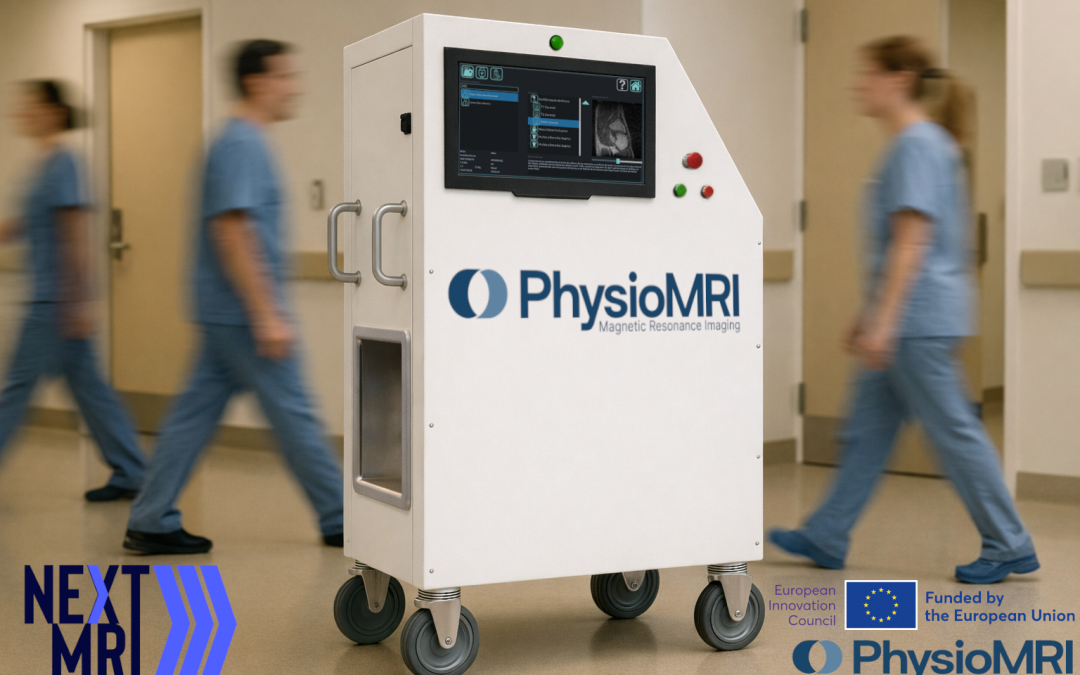
The design of the equipment is based on a robust and mobile structure, with a white casing featuring clean lines and smooth surfaces that convey a sense of precision and modernity. The device is mounted on four wheels for easy movement, allowing it to be moved between rooms effortlessly. This mobility makes PhysioMRI’s MRI scanner an ideal tool for environments where space or traditional MRI scanner infrastructure are limiting factors.
The side panel is dominated by a large-format touchscreen, from which the system is controlled and the acquired images are displayed. The interface combines an intuitive layout with a technological aesthetic, designed for real-time use by medical professionals or researchers. Next to it, a set of physical control buttons—in green and red—provides redundancy and safety during device operations, ensuring easy handling even in demanding clinical conditions.
Another noteworthy aspect of the design is the inclusion of handles and a rear access door with a circular opening, as part of the rear of the gantry (main hole of the resonance). These details reflect the attention paid to ergonomics and maintenance, fundamental aspects for a device that seeks to combine scientific precision with practicality for everyday use.
The philosophy behind this innovative project is clear: to take magnetic resonance imaging beyond traditional limits, providing a flexible and accessible platform that maintains image quality and diagnostic reliability, but with a simplified infrastructure. In this sense, the design not only serves an aesthetic function, but also embodies PhysioMRI’s vision of democratising access to MRI technology through portable, sustainable and efficient solutions.
With its vision of portable magnetic resonance imaging, PhysioMRI reaffirms its commitment to innovation applied to human well-being, promoting a new generation of magnetic resonance imaging systems that combine mobility, precision and intelligent design, paving the way towards a future in which advanced diagnostics are truly accessible anywhere.
